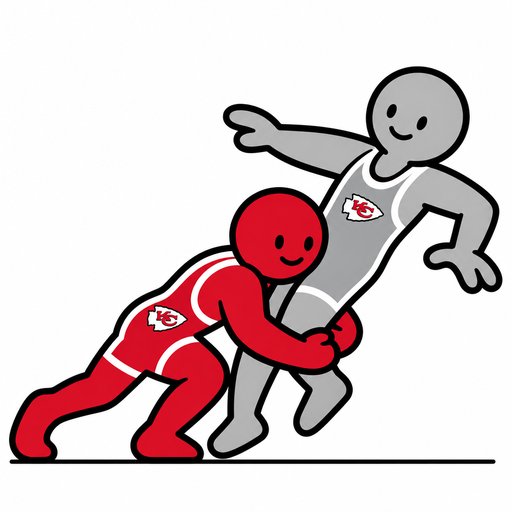
 3Takedown
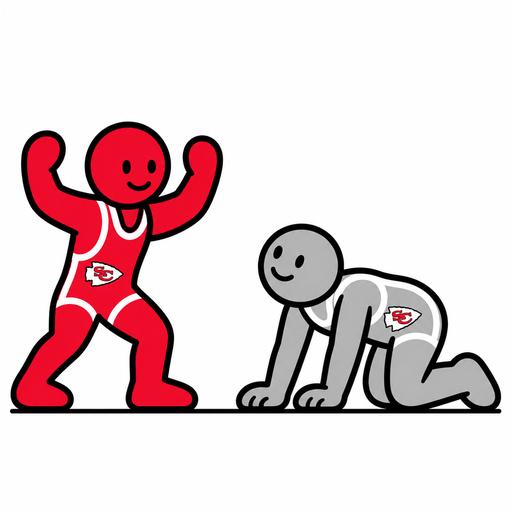 1Escape
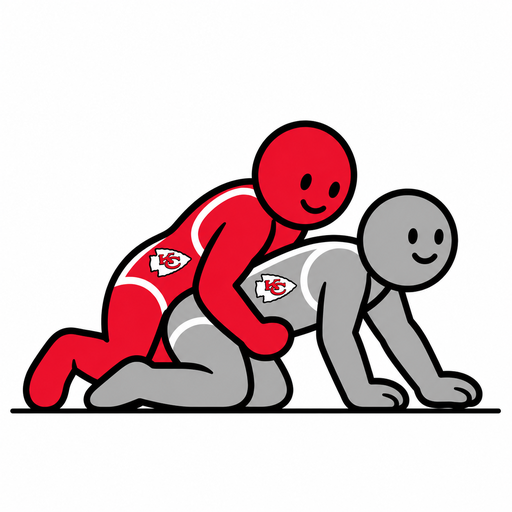 2Reversal
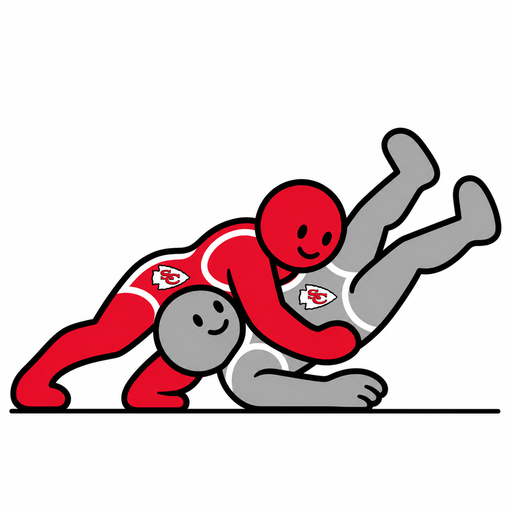 2-4Near fall
 15Tech fall lead
 PINEnds it now
Plain language, no experience needed. Everything in this layer is enough to follow any match on our schedule.
The whole sport in one sentence
Two wrestlers try to take each other down to the mat and hold each other's shoulders flat on it, and the one who controls the action earns points along the way.
That is really it. Everything else on this page is detail. Good detail, the kind that makes a close match in the third period feel like the best seat in the gym, but detail all the same.
The pin: why everybody jumps up
A pin, also called a fall, is when one wrestler holds both of the other wrestler's shoulders flat on the mat at the same time, for a full two seconds. The referee gets down at mat level, checks the shoulders, and slaps the mat.
The match is over the instant that happens. It does not matter who was winning on points. A wrestler can be behind by ten points, hit one big move, hold the shoulders down, and win. That is why the whole bench comes off its chairs. In wrestling, nobody is ever out of the match until the final whistle.
Three periods, one quick picture
A high school match has three periods of two minutes each. In the first period, both wrestlers start on their feet, facing each other. In the second and third periods, the wrestlers take turns choosing how to start: on their feet, or on the mat, with one wrestler on top and the other on the bottom. The bottom wrestler tries to get away or turn the tables. The top wrestler tries to keep control and work for a pin.
The lead changes hands a lot, and a wrestler who is behind can score in bunches late. Stick around for the third period. That is usually when the match is decided.
What just happened, and what it was worth
How a match ends
- Pin (fall). Shoulders flat for two seconds, the referee slaps the mat, and the match is over on the spot. The most exciting finish in the sport.
- Technical fall, called a tech fall. One wrestler builds a lead of 15 points and the match stops early, because the lead is too big to chase. Think of it as the mercy rule, earned one move at a time.
- Major decision. Time runs out and the winner is ahead by 8 to 14 points. A clear, comfortable win.
- Decision. Time runs out and the winner is ahead by 7 points or fewer. These are the nail-biters.
- Overtime. If the score is tied when time runs out, the match keeps going. The second layer of this page explains exactly how overtime works.
Reading a result
Every bout on our bracket cards and recaps carries a short code next to the score. The code says how the bout ended. Here is the full set, in plain language.
Reading the marks
On our bout cards, a wrestler's name may carry small medal marks after it. The marks are honors he has already earned, so you can spot a good wrestler before his bout starts. A medal's color tells his best finish at that level: gold for a champion, silver for a runner-up, bronze for third place. A blue star means he placed without reaching the top three. The letters name the level.
A number in front of a mark, like 3×, means he earned that same finish that many times. A star at State, Sectionals or Area means 4th through 6th place. Marks come only from verified honors on file, and youth Kids State honors do not earn marks.
Dual meets: team against team
Two schools line up against each other, one wrestler per weight class, and every individual match adds team points to the school's total. There are 14 weight classes, from 106 pounds up to 285, so the team score grows bout by bout and the lead can swing all night.
| How he wins | Team points |
|---|---|
| Decision (by 1 to 7) | 3 |
| Major decision (by 8 to 14) | 4 |
| Tech fall (by 15) | 5 |
| Pin, forfeit, or default | 6 |
A pin is worth double a decision, so one big fall can erase a lead in a single bout. When the crowd starts doing math out loud late in a dual, this is the math they are doing.
Tournaments: everybody in the bracket
Wrestlers are placed into a bracket at their weight, usually seeded so the strongest wrestlers do not meet in the first round. Win and you advance toward the final. Lose and you drop into the wrestleback rounds, where you can still fight back to a top finish at many events.
Each wrestler earns team points for advancing, for placing, and for winning big: pins and tech falls add bonus points. At the end of the day, the school with the most total points takes home the team trophy. Tournaments run long, sometimes two days, and the final rounds under the lights are worth the wait.
Five things a new fan should watch for
- The first takedown. It sets the tone. The wrestler who scores first usually gets to wrestle his match.
- Hands and head position. Before any big move, watch the tie-up. Good wrestlers control the other man's head and hands. The move you see starts there.
- The referee's hand sweep. When the referee kneels and starts sweeping one hand, a wrestler is close to a pin and near fall points are building. The bench will be counting along.
- The bottom wrestler's hips. Escapes and reversals start with the hips getting free. If the bottom man's hips are moving, something is about to happen.
- The third period score and the clock. Close match, one takedown wins it, thirty seconds left. There is nothing in sports quite like it. Now you know enough to feel it.
Reading the referee
One wrestler wears a red ankle band and the other wears green. The referee wears a matching band on each wrist, and the arm he raises tells you who scored: red arm, red wrestler. The number of fingers he shows is the number of points.
Tiny glossary
The full book, in brief: current NFHS values as used in Georgia, including the 2024-25 rules changes.
Full scoring table
| Play | Points | Notes |
|---|---|---|
| Takedown | 3 | Control beyond reaction time. Raised from 2 in the 2024-25 rules. |
| Escape | 1 | Bottom wrestler regains neutral, facing the opponent. |
| Reversal | 2 | From underneath to a position of control on top. |
| Near fall | 2 / 3 / 4 | By the referee's count: a 2-second hold earns 2, a 3-second hold earns 3, a 4-second hold earns 4. |
| Near fall, stopped | 5 | If a 4-point near fall is earned and the match then stops for the defensive wrestler's injury or bleeding, the award is 5. |
| Caution | 0, then 1 | False starts and incorrect starting position. Two cautions are free; from the third on, each costs a point. Cautions alone never disqualify. |
| Technical fall | Ends it | A 15-point lead. If the lead is built by a takedown or reversal straight into near fall, wrestling continues until that sequence ends. |
| Fall | Ends it | Both shoulders or scapulae held on the mat for 2 seconds. |
Match length is 2-2-2, first period neutral, with choice of position in the second and third periods decided by the disk flip. In bounds is one point of contact of either wrestler inside or on the boundary line, a 2024-25 change that replaced the old two supporting points standard.
Overtime
Penalty progression
Illegal holds, technical violations such as locked hands and fleeing the mat, unnecessary roughness, and in-match unsportsmanlike conduct all run on one chart:
- First offense: 1 point to the opponent
- Second offense: 1 point
- Third offense: 2 points
- Fourth offense: disqualification
Flagrant misconduct skips the chart entirely: disqualification, removal from the event, 3 team points deducted, and in a tournament every point the wrestler earned is wiped out.
Stalling: its own track
- First call: warning only
- Second call: 1 point to the opponent
- Third call: 1 point
- Fourth call: 2 points, and the opponent gets choice of position on the restart
- Fifth call: disqualification
Stalling is judged on action, not position: backing off the mat, sitting on the bottom without working up, riding parallel with no attempt to turn, and refusing to engage all draw the call. A coach's misconduct draws a warning first, then team point deductions.
The clocks on the side of the mat
Injury time is capped at 1 minute 30 seconds per match, across no more than two timeouts; a wrestler who cannot continue when it runs out loses by default. Blood time runs on its own 5-minute clock and does not count as an injury timeout. Recovery time, 2 minutes, goes to a wrestler hurt by an illegal hold or slam; if he cannot continue after it, he wins by default.
When a dual ends tied
The NFHS criteria decide it, in this exact order. The first criterion that separates the teams wins the dual, and 1 team point is added to the winner's score. Conduct comes first, which surprises people:
- Fewer team points lost to flagrant misconduct or unsportsmanlike deductions
- Fewer team points lost to coach misconduct deductions
- Fewer match points given up for unsportsmanlike conduct during matches
- More bouts won, forfeits included
- More six-point wins: falls, defaults, forfeits, disqualifications
- Fewer forfeits given up
- More technical falls
- More major decisions
- More match points from scoring first
- More near fall points
- More takedowns
- More reversals
- More escapes
- Fewer stalling points given up
- Fewer stalling warnings
- Fewer other penalties, such as false starts
- A flip of the disk
This is why a coach chases a major in the last bout of a tied dual instead of settling for the decision, and why giving up bonus points early can lose a dual the bout count says you won.
Tournament team scoring
Advancement: 2 team points for a win on the championship side (except the final itself), 1 point for a win in the wrestlebacks (except the placement finals). A bye scores only if the wrestler wins his next match; then the bye round's advancement counts too.
Bonus, on top of advancement: fall, forfeit, default, or disqualification win, 2 points. Tech fall, 1.5 points. Major decision, 1 point.
| Places scored | 1st | 2nd | 3rd | 4th | 5th | 6th | 7th | 8th |
|---|---|---|---|---|---|---|---|---|
| 4 places | 14 | 10 | 7 | 4 | ||||
| 6 places | 16 | 12 | 9 | 7 | 5 | 3 | ||
| 8 places | 16 | 12 | 9 | 7 | 5 | 3 | 2 | 1 |
Team races at tournaments are won in the wrestlebacks as much as in the finals. A full lineup that keeps scoring small points on the back side of the bracket beats a short lineup with two champions almost every time.
The 14 weight classes
Wrestlers weigh in on the day of competition, and every wrestler's weight is certified before the season under Georgia's weight management program, which sets the lowest class he may wrestle and how fast he may get there. The referee checks skin before every meet. Georgia also caps a wrestler at 6 matches in a day, with at least 30 minutes of rest between matches.
Georgia's path: Area, Sectionals, State
The dual season runs its own parallel path: each Area sends its top 2 teams to the State Dual Tournament, decided dual by dual, with tied duals broken by the criteria above.
High school vs college: what changes
| Topic | High school | College |
|---|---|---|
| Periods | 2, 2, 2 minutes | 3, 2, 2 minutes |
| Takedown | 3 points | 3 points |
| Near fall | 2, 3, or 4 by the count | 2, 3, or 4 by the count |
| Riding time | None. Control alone scores nothing. | 1 point for a net riding time edge of a minute or more |
| In bounds | One point of contact in or on the line | Any part of either wrestler in bounds or within the cylinder |
| Tech fall | 15-point lead | 15-point lead |
| Overtime | Sudden victory, tiebreakers, then the ultimate tiebreaker ride | Longer sudden victory, tiebreakers where riding time can decide it |
The heart of it is the same at both levels: control the mat, chase the fall, and never stop scoring.